Saturday, March 24, 2007

OpenGL Tetris in Haskell

Over the past couple weekends I've tried putting my new language interest, Haskell, through the paces by witting a version of Tetris with HOpenGL bindings. Herein is an overview of my progress, and a call for help from the more experienced in the Haskell community to show me and other newbies how this can be improved and why.

The Good
As noted, um, everywhere, Haskell is a really deep language. As a beginner, the features that have struck me are the ease of defining functions, pattern matching in definitions, currying, and the seemingly endless stream of higher order functions.

Making function definitions as easy as variable assignments in other languages encourages me to break apart logic and leads to cleaner code. Defining functions in the `where` clause I've found to be especially handy and elegant. Unlike imperative programming, where code with very similar functionality can hide in a jungle of statements, repeating code in Haskell is easy to pick out and convenient to factor out.

Pattern matching in function definitions has been incredibly handy. In Perl, I'll often use a hash to map things like tetris shapes to their set of points. Haskell's version is more useful because I can define a function which takes a shape and returns a set of points associated with it. The difference is I can pass this function around or use it in higher order functions without using extra syntax to do the lookup.

Currying without any extra syntax is a big contributer to Haskell's clarity. Now that I've experienced it's usefulness, I don't think I could go back to languages like Scheme without constantly complaining about its absence.

Besides the standard `fold` and `map`, I find myself thinking "Wow, that will be usefull" whenever I look through Haskell's standard libraries. Functions like `zipWith` or `unionsWith` make even the most useful Java classes look barbaric.

The Bad
When I first started writing Haskell, the thing I found most annoying was the big change in associativity. The downside of functions being treated exactly like data is that it becomes impossible for the compiler to correctly predict how you want things grouped. It didn't take long to become accustomed to Haskell's rules, but for whatever reason learning to use $ and . correctly took a bit time.

Monads obviously need to be included in this list, but I found understanding the simple monads such as IO, Maybe, and Either simple enough to quickly make progress. I have not implemented my own, and I suspect my Tetris code could be significantly improved with better understanding, so I'll be digging into this area again soon.

Typing has not been a problem for me. Haskell's typing inference system works great, and the times I've run into typing errors have been either an error in my code (most frequently), or, in my belief, a bad framework for what I was trying to accomplish.

The Ugly
I've basically run into the same problem with libraries and setup documented by Eric. Documentation of libraries could also use a lot of improvement. Here's an example of documentation for a function in some introspective code that I was trying to understand:
mkConstr :: DataType -> String -> [String] -> Fixity -> Constr
Constructs a constructor
Not very helpful.

What About Tetris?
First off, I don't think that Tetris and OpenGL map onto Haskell very easily. OpenGL in particular is very stateful, and even setting up a simple animation requires using Monads to work around Haskell's lack of side effects. I think this excersize is still useful, though, because in pushing a language to it's boundaries and forcing you to use it's less hyped features, you can often getter a better understanding of it's strengths and limitations. Before starting this project, I read over Michi's posts. In fact, his cube generation code is largely unchanged in mine.

What I'd like to see happen is for the amazingly helpful Haskell community (seriously, check out #haskell some time, it is the nicest, most helpful channel I've visited) to take my crappy code, explain why it sucks, and show me and other timid beginners how to do better. Just add a comment to where people should look for improved versions.

My code is available at PBWiki.

Tetris.hs
This is the code that kicks off the OpenGL loop. Callback functions are used to display objects, coordinate movements, and set state. You can see by the number of newIORef calls how much state is being passed around to each callback. The most confusing line here is probably the assignment to curMatrix. curMatrix keeps track of the matrix transformations that occur when the mouse is moved so you can use a "glass ball" type interface to rotate the tetris board around.

Display.hs
This file contains the display call backs that render the pieces and board. To implement the mouse interface, the display matrix is reset with loadIdentity. The new translations from the most recent mouse movement are applied, then the previous matrix is applied.

dropPiece drops the current piece, or sets the fallen piece and starts a new one.

idle is a callback that is continually called and it simply asks OpenGL to redisplay the screen in it's next loop. This is the alternative to calling postRedisplay after all movement changes.

TetrisPiece.hs
This file contains the code that keeps the coordinates for shapes and instructions on how to render them. translatedPoints is a function which can take the default coordinates of a shape and apply the transformations that the displayed shape receives so that collision detection can be done.

TetrisBoard.hs
Setup for the shape of the board and the boundary initialization are done here. tableMap is basically an array of all the (x,y) coordinates with False inside the boundaries (because there are no fallen pieces yet), and True along the boarders.

clearLines takes a board and clears any full lines; basically, the purpose of Tetris. Using foldl, it iterates over a list of lines given by their 'y' coordinate. For a given line, if that line is at or above 'y', it takes the contents of the line above it. The base cases are the boarders of the board, which should keep their boundaries.

Sorry for the mixed naming, by the way. 'board', 'b', 'tableMap', 'boarder' are all generally the same thing: the mapping of the contents of the Tetris board, ie the fallen pieces.

Bindings.hs
keyboardAct defines how a key press can move a shape on the board, while movePiece determines if this movement is valid.

Translations.hs
These functions are used to calculate translated points for collision detection and the "tetris unit" is defined here. Using `tunit` not only helps to keep things in correct proportion, but it also helps Haskell's typing inference when used as a unit.

Thursday, March 15, 2007

Lessons from Ops

I am a programmer who enjoys working "only slightly removed from pure thought-stuff." But when I left college I chose a job that was decidedly oriented toward beating this thought-stuff into the ground of reality. I wanted to learn the details of how to program large-scale, heterogeneous systems that were possible, if not easy, to maintain. Not "maintain" in the programmer sense of the word (ease of adding new features, finding bugs, etc.), but maintain as in enabling users to understand, control, build upon, and rely on the system.

Oh, That's Typical
I'm going to stay away from the common recommendations such as DRY because I'd like give specific pointers that apply to the situations I've seen. The hope is when I write programs in the future, the tips herein will pop back into my mind and I'll produce systems that are easy to debug, understandable by people uninvolved in the development, and predictable.

Doesn't Play with Others
A data problem was reported to our team the other day. Typically, finding the source problem requires a large amount of domain knowledge: where are the files that configure the various transformations that this data goes through? Who typically publishes this data type? Where are the logs that may have information about this document? The path to resolution is like a little known covered wagon trail through the Sierras: you need an expert guide and most of the time you get stuck at Donner pass. What should be provided is a yellow brick road: it may require a little work to get there, but you know where you need to take your next step.

Introspective vs. Transparent
At it's root, debugging is about figuring out what happened and why. To provide an easily debuggable system, simply provide the what and why at every step that business rules are applied. Just as importantly, provide it as a service in the same way that interested parties normally interact with your system. Adding `printf`s to your code is great for programmers who usually interact with a service on the command line or `tail` files, but it is nearly useless for clients.


The Boudin bakery in San Francisco is transparent, literally. You can see them mix the dough, cut bread, and bake it. But that doesn't let me understand any of the decisions they've made; I couldn't go home a bake delicious sour dough in which to put clam chowder. In order to do that, I'd need to interact with the cooks in the normal way: ask questions, have them explain what's going on.

Except for the most basic services, data transparency is not that helpful. Think about the questions you'll get from users. When did this data change? Who changed it? Where did it come from and how did it get transformed? How would the system react in different situations? These are the questions that need to be answerable in a straightforward manner.

If you're worried about performance, or exposing too much information to customers, keep in mind that introspection is a system property. It doesn't have to live in your main service, especially when lots of historical data is desired. It would be nice, since people don't have to learn a system with more components, but it's not a requirement. Unique identifiers (database keys, document IDs, URLs) should be usable across the system so a story can be put together programmatically. A coworker of mine suggested that the public password for a system we are developing should be the URL of a wiki page they should read before using the service. I love this idea because it eliminates an often fruitless search for information and directly ties the wiki service into the overall design. Think how useful it would be to have wiki links for each error your service produces along with the ID of the data that was involved in the problem.

You From Around Here?
Even programs with great documentation can't cover all of the potential questions from a new user. Often users can't express their issue in the jargon that would enable them to find and understand the solution. Providing a way to "show and tell" what's going on gives users a chance to understand from experience. Just as languages with an interactive shell and introspection let users get an intuitive feel, systems should provide users with meta-information that they can manipulate.

To Be Continued
This turned out longer than expected, so I'll continue in a later post. Leave comments so I can improve my writing and ideas.

Wednesday, March 14, 2007

Medium Work Route with Shortcut

This bike route to work takes me through Arastradero Open Space Reserve. This year I have only ridden the route with the Alpine shortcut. The ride takes about an hour at a strong pace. Two quick but steep climbs make the ride good for training even given its short length.


Since last year, they've repaved many of my common routes. Especially improved is the Ellen Fletcher bike boulevard that I take home from work. All last year I had to worry about flat tires, hidden potholes, and a generally jarring ride on a road supposedly designed for bikers.

With the weather getting up to the 80s, my whole house now a fan of cycling, and increasing time pressure to get ready for the AIDS ride, I hope to get out a lot more in the coming weeks.

Tuesday, March 6, 2007

Cycling the Saratoga Loop

J and I decided to bike out to Saratoga, he to get to I's house, and me to burn off some of the cookies I'd had at my folks' place over the weekend. We started off a moderate pace, and J, champion that he is, requested we kick it up a notch. Soon we were at the top of our first hill overlooking the Steven's Creek Reservoir. Here's the map on Google Maps.

The climb up to the Reservoir is about 250 feet, and the view is pretty nice up there. I've been meaning to have a picnic by the river in the valley; it's very lush and peaceful. Next was Mt. Eden, a tough hill for anyone, especially a beginning cyclist. In fact, it was about 1 year and 1 month ago that I had climbed this hill as a newbie and was so tired afterward that S came to pick me up from Saratoga. It's also about 300 feet, but squeezed into a single mile. But it too was conquered, and we wound our way down the hill and made it to I's house in about 1 hour. There I made my questionable decision to take a different route back.

With J dropped off, I decided I wanted to take a loop back. An additional draw was the fact that I hadn't taken the Hwy 9 to Hwy 35 route before, but I knew it had great views of San Jose and wound through the forest most of the way. The climb up 9 turns out to be just over 2000 feet. Who knew? Well, I do now, and it was pretty painful. It's good to know that I haven't lost too much cycling power over my break, but I think it would have been healthier for me to work up to rides like this.

Wednesday, February 21, 2007

Wine Tasting in Livermore

S and I went to Livermore to do some wine tasting. Yes, I'm sure it was wine, not bootleg grape juice brewed in the basement of a suburban sprawl home and run across the county line by a soccer mom in her SUV. We got a late start on President's Day so we only made it to three wineries instead of the dozen or so we were hoping for. I made a notebook of these Southbay Wineries. or you can buy my source, The Best of the Wine Country. WARNING: The following contains extreme yuppyism, for I am about to discuss wine. Please resist the urge to punch me in the face after reading this to restore your street cred.

Retzlaff Winery


Because of it's small size and smooth wines, this was a good place to start. When we arrived, the hostess was the only person in the tasting room. After tasting a few wines, I readily admitted that we were fairly new to the wine tasting circuit. This started a pattern that would repeat itself for the rest of the day: the hostess completely opened up, took us on a tour of the aging rooms, and let us sample different vintages, from the casks, for free. It was a great to see the evolution of the wine, starting with an '06 recently picked, to a dark '01. The thing that surprised me most was how much the wine changes in the first year ('06 compared to the '05). It was another example of the last 10% improvement costing the most.

Neither S nor I like Chardonnay, but the version here was very clean and didn't have the dry oaky flavor that normally turns me away. The reds were also clean; too clean actually. I prefer the bolder wines we found later that day.

Concannon Vinyard

Quite a contrast to Retzalff, Concannon had a large storehouse and tasting room. The medium sized parking lot was full, so we were looking forward to a different experience. President's Day weekend the winery opened its reserve wines for tasting, pouring them at different stations complemented by cheese or chocolate. Again I started asking newbie questions at one of the later stages and struck up a conversation with the folks behind the table. Before I knew what was happening, S and I were whisked away and had started a private tour of the winery.

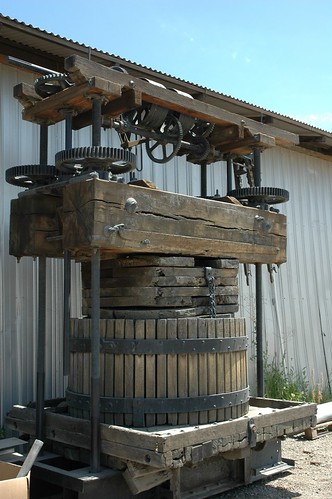
We started outside, looking at the hoppers which separate the grapes from the stems and leaves. Taken through the distillers, mixers, and filters we asked questions and got to poke our heads into some of the empty steel containers. Andrew, our host, gave us a few lessons on how they buy, care for, and use the wine casks. The above picture is one of the original grape presses that was used by the founder, James Concannon.

Jim Concannon is the grandson, and now runs the vineyard. We met him in the storage room, where the casked wine was held at a constant 54 degrees. Jim told us about climbing around the old room when he was young, pointed out the grooves in the floor where the draft horses used to haul full casks in or press grapes, and explained that the winery was only able to stay open during the prohibition thanks to the communion wine needed by the local churches.

Petite Syrah is the Concannon specialty. For me, though, this wine ended very abruptly. The "full" Syrah was more enjoyable and the Merlot was excellent: very bold. They had a new-to-me Spanish style wine, Contenello (?), that was nice and spicy. The whites were disappointing.

Crooked Vine

Crooked had an enlightening barrel tasting scheme: there were three casks, two different types of grapes, and two different types of wood. I was surprised that the type of wood, French Oak versus American, had already altered the taste of the wine. These casks were also '06 wines, so they hadn't been aging long. We talked with the hostess about the job of the head winemaker: how do they know when a wine is done? What are they looking for? How do they blend? The answer to all the questions is basically "whatever feels right to him/her." This drove the personalization of the wine home for me: with so many ways for a grape to interact with its soil and environment, the resulting juice to interact with its cask, the resulting wine to be tweaked and aged by a wine expect, and the end product to interact with the taster, no wonder there are so many variations.

I highly recommend a trip to this area, and you'll be reading about my next one.

Saturday, February 17, 2007

2 Nights in Dublin

B is going to Dublin, Ireland for two nights, so I thought I'd write a schedule. I visited Dublin this last December, sent by work. I had an amazing time and was able to pick up a lot about the city from walking around, talking to people, and visiting the museums.

Background

The main part of the city is quite small, which makes walking around easy. If you have time, you don't really need a schedule since you can just walk to wherever you feel like visiting next. Additionally, walking around makes it easier to find the place you're going. There's approximately 50 million small streets in Dublin, and if that wasn't enough, the main through streets change their name every couple of blocks. I suspect this is why I never found any Mapquest equivalents for Dublin.

I think the best way to enjoy Dublin is to appreciate the contrast the city has. Visit an old museum, then sit in a bar talking to locals. Visit Kilmainham then view some modern art. One of the reasons visiting other counties is so interesting is because that kind of contrast doesn't really exist in America.
Schedule

OK, I'll stop rambling now. If you're there for two days, here's what I'd pack in.

Day 1 Morning
  • Check into the Paramount
  • Walk through the street market, get some breakfast at the food square at the beginning of Temple Bar district
  • Walk back past Paramount, take tour of Christchurch, including the crypts.
Day 1 Noon

  • Walk to Guinness Storehouse, take the tour, have a pint in the Gravity Bar
  • Look across the street, see the Digital Hub which is where the Amazon office is
  • Have lunch at Nash's, aka DUB0, on Thomas St.; order Guinness' seasonal beer
Day 1 Afternoon
Day 1 Evening
  • Catch last Hop-on-Hop-off bus, get off at Jameson's Whiskey stop
  • Buy tickets for Jameson tour (discount with bus ticket), buy an Irish Coffee while you wait
  • Sit in the front row during Jameson tour movie, immediately raise your hand when guide asks who wants to be a special taster
  • After tour, cross back over the river on Hapenny bridge and eat at Guel
  • Walk to Peter's Pub off Graffton, sit at the bar, talk to people, try Green Spot, drink Guinness
  • After 10:30p, go to O'Donoghue's watch great live music
  • Stumble back to Porterhouse, across the street from Paramount, drink more
  • If you're hungry, eat at Zaytunes
  • Sleep
Day 2 Morning
  • Have an Irish Breakfast
  • Catch Hop-on-Hop-off bus, listen to tour
  • Hop off at Stephen's Green, walk around
  • Buy Green Spot at Celtic Whiskey
  • Walk along Nassau street, buy things
Day 2 Noon
  • Go to Dawson's Lounge, have pint(s) and lunch (if you are hungrier than a sandwich, eat at Kilkenny's cafe)
  • Walk through Trinity College, see Book of Kells
Day 2 AfternoonDay 2 Evening
  • Get fish & chips at Leo Burdock
  • Go to Bar Restaurant on St. George's St., get a Guinness and a brownie at the bar
  • Walk through Temple Bar, get a cocktail at one of the sleek hotel bars
  • Go back to your favorite bar, or for a longer walk, go to Mulligan's
Day 3 Morning
  • Pack and take cab to airport
  • Have pint and go home. Good job!
What did I misss?

Tuesday, February 13, 2007

OK, This Is Very Exciting

Sam Adams has developed a new beer glass.


As my beer snobbishness grows, I find myself unable to drink out of plastic cups any longer. I suppose it's not long till I can't drink out of glasses not specifically designed for the type of beer I'm drinking. Frankly, I already have a hard time drinking out of glasses that have a Bud or Coors label on them. As a geek in general, I'm also particularly attracted to using the "do one thing and do it well" philosophy, so specialized glasses appeal to me.

I view Sam Adams as a middling microbrew that hit it big. The beer is still better than the rest in its class, but its class isn't great. I respect them for trying to raise the level of national American beers and maybe serving as a "gateway beer" for many people. Of light beers, Sam Adams is the best (probably because it was developed by the inventor of light beer), but again: not a class of beer I enjoy.

I like seeing companies using their popularity and profits to do interesting things that advance their field. Google is an obvious example. The glasses are on their way to me now, so I'll let you know if Sam Adams is now an example, too.